


Kirsten Fisch
Co-Founder at - Momentum Health NetworkKirsten Fisch, MSN, RNC-MNN, IBCLC, LCCE Kirsten is a women's health nurse who specializes in high-risk pregnancy and postpartum care. She is certified in Maternal Newborn Nursing, a board-certified lactation consultant (IBCLC), and a Lamaze Certified Childbirth Educator. She works with women from conception through the postpartum period. Passionate about empowering women throughout their reproductive journeys, Kirsten combines evidence-based care with compassionate support to promote the health and well-being of mothers and babies.
When you’re pregnant, you probably don’t spend much time thinking about medical billing.
You think about finding a provider you trust. You think about ultrasounds, prenatal appointments, labor, delivery, and bringing your baby home. The financial systems operating behind the scenes are usually the last thing on your mind.
But those systems matter.
The way healthcare is paid for influences how care is delivered, how providers are reimbursed, and sometimes even what services are available to patients. That is why a major change coming to maternity care in 2027 is worth paying attention to, even if most families will never hear about it.
Beginning January 1, 2027, maternity care billing in the United States will undergo one of its most significant changes in decades.
While the details may sound technical, the questions behind the change are surprisingly simple:
- How should maternity care be paid for?
- What services should be counted?
- How do we make sure the payment system reflects the care women actually receive?
A Quick Look Back
For many years, maternity care has been billed using what is known as a global maternity bundle.
In simple terms, that means prenatal care, delivery, and postpartum care were grouped together into a single payment structure.
The approach offered advantages. It simplified billing and created a predictable system for providers and insurers.
But maternity care has changed.
Today’s pregnancies are often more medically complex than they were decades ago. Women may receive care from multiple providers throughout pregnancy and after delivery. At the same time, growing attention has been placed on the postpartum period, when many maternal health complications occur.
As a result, some professional organizations and specialty societies began asking whether the existing payment structure still reflected the realities of modern maternity care.
What Is Changing?
Beginning in 2027, maternity care services will be reported in a different way.
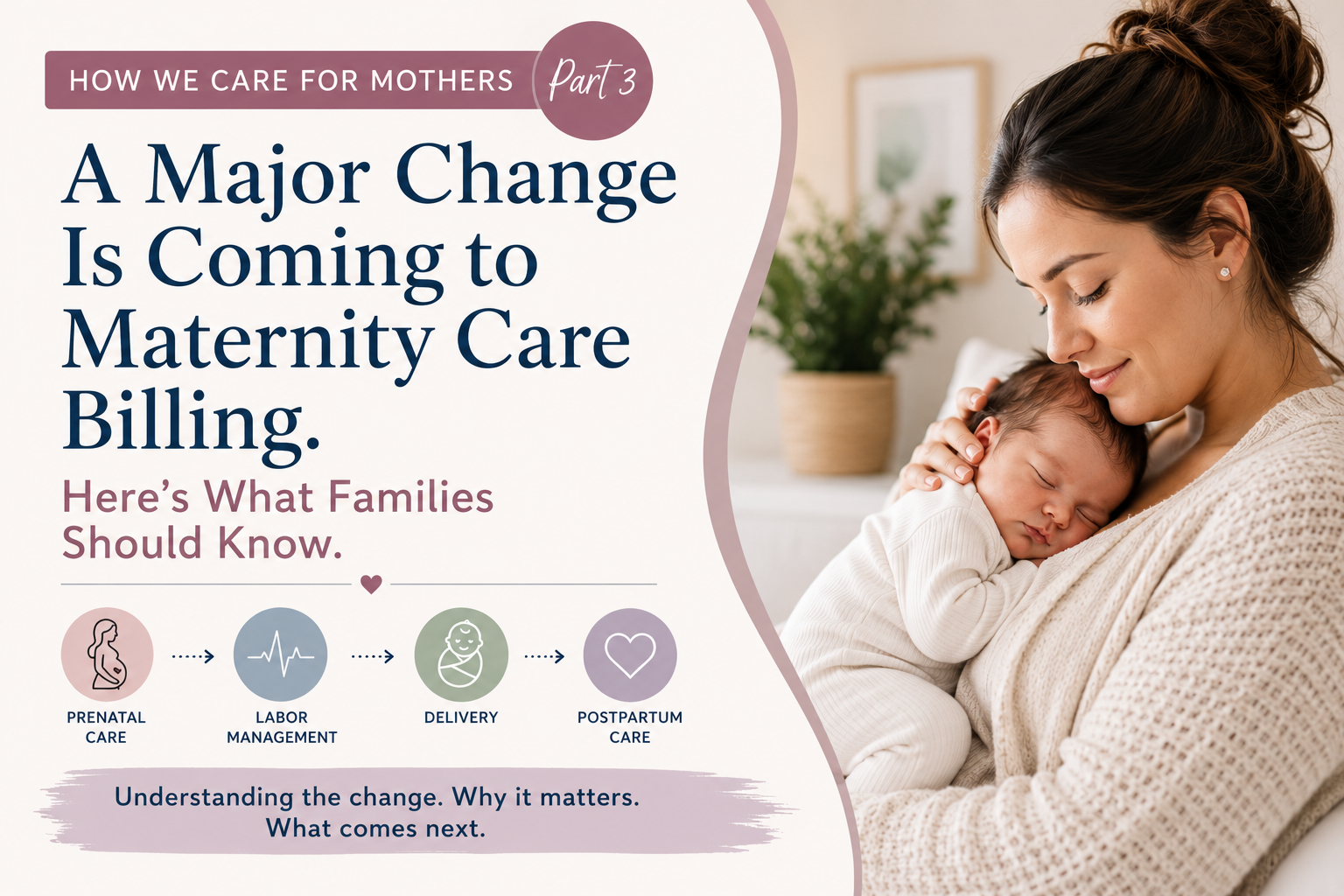
Rather than relying primarily on a single bundled payment, care will be divided into four phases:
- Prenatal care
- Labor management
- Delivery
- Postpartum care
Supporters of the change say this approach better reflects the different types of care women receive throughout pregnancy and after birth.
Critics have raised concerns about complexity, administrative burden, and the possibility of higher costs for some patients depending on how insurers implement the new structure.
At this point, many of the details are still being worked out.
Federal reimbursement rates have not yet been finalized, and insurers will need time to determine how they will incorporate the new codes into their plans.
Why Some Experts Support the Change
Supporters believe the new structure could provide a clearer picture of the care women actually receive.
One area receiving particular attention is postpartum care.
In recent years, maternal health experts have increasingly focused on the weeks and months following birth. Conditions such as postpartum hypertension, infection, mental health challenges, and delayed recovery often emerge after a woman leaves the hospital.
Supporters argue that separately reporting postpartum services may help healthcare systems better understand how care is delivered during this period and identify opportunities for improvement.
Others believe the changes may provide better data about maternity care overall by creating a more detailed picture of services provided throughout pregnancy and postpartum.
Why Others Are Concerned
Not everyone views the changes the same way.
Some health policy experts worry that moving away from bundled payments could create incentives for more billable services without necessarily improving outcomes.
Others are concerned about patient costs.
For families enrolled in high-deductible health plans, more detailed billing could potentially affect out-of-pocket expenses depending on how insurance companies implement the new structure.
Many healthcare organizations are also preparing for the practical challenges of updating systems, contracts, and workflows before the changes take effect.
At this point, much remains uncertain.
Why This Matters
This billing change is happening at a time when maternal health is already receiving significant attention across the country.
In Part 1 of this series, we looked at the current state of maternal health in America and the challenges reflected in maternal mortality and morbidity data.
Read Part 1: The State of Maternal Health in America: What the Numbers Actually Tell Us
In Part 2, we explored the programs and policies that help support maternal health and why ongoing debates about funding matter.
Read Part 2: The Programs Behind Maternal Health and Why They Matter
Now another piece of the system is changing: the way maternity care itself is paid for.
Whether these billing changes ultimately improve care, increase costs, create better data, or produce unintended consequences remains to be seen.
What we do know is that the financial systems supporting maternity care are changing at the same time policymakers, providers, researchers, and advocates are debating the future of maternal health itself.
Both conversations have the potential to influence what care looks like for mothers and babies in the years ahead.
Continue the Conversation
For readers interested in the professional side of this topic, I take a deeper look at the policy and reimbursement implications in my LinkedIn article:
The Quiet Billing Change That Could Reshape Maternity Care
Up Next
Part 4 of How We Care for Mothers explores a simple but important question:
What actually works?
We’ll look at the evidence behind some of the most promising approaches to improving maternal health, including community-based doulas, midwifery models, telehealth, continuity of care, and extended postpartum support.

Kirsten Fisch, MSN, RNC-MNN, IBCLC, LCCE Kirsten is a women's health nurse who specializes in high-risk pregnancy and postpartum care. She is certified in Maternal Newborn Nursing, a board-certified lactation consultant (IBCLC), and a Lamaze Certified Childbirth Educator. She works with women from conception through the postpartum period. Passionate about empowering women throughout their reproductive journeys, Kirsten combines evidence-based care with compassionate support to promote the health and well-being of mothers and babies.