

Kirsten Fisch
Co-Founder at - Momentum Health NetworkKirsten Fisch, MSN, RNC-MNN, IBCLC, LCCE Kirsten is a women's health nurse who specializes in high-risk pregnancy and postpartum care. She is certified in Maternal Newborn Nursing, a board-certified lactation consultant (IBCLC), and a Lamaze Certified Childbirth Educator. She works with women from conception through the postpartum period. Passionate about empowering women throughout their reproductive journeys, Kirsten combines evidence-based care with compassionate support to promote the health and well-being of mothers and babies.
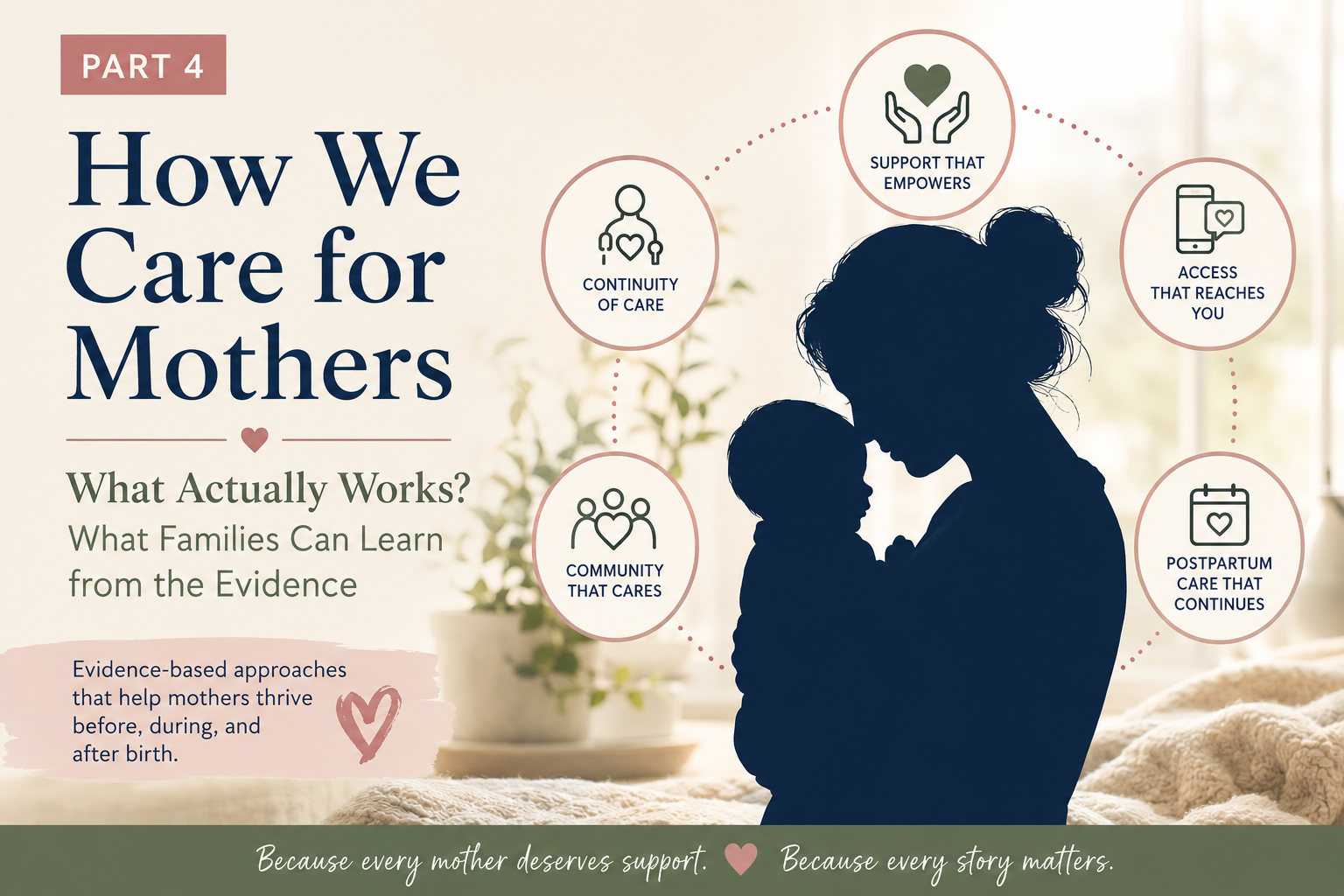
Part 4: What Actually Works? What Families Can Learn from the Evidence
The first three articles in this series have focused on systems.
We’ve looked at maternal mortality rates, federal programs, funding debates, and changes to the way maternity care is paid for. Those conversations matter because they shape the experience of pregnancy and postpartum care for millions of women every year.
If you’re just joining the series, you can catch up here:
Part 1: The State of Maternal Health in America: What the Numbers Actually Tell Us
Part 2: The Programs Behind Maternal Health and Why They Matter
Part 3: A Major Change Is Coming to Maternity Care Billing. Here’s What Families Should Know
But after spending weeks researching those topics, I found myself returning to a simpler question:
What actually helps?
As a postpartum nurse, I’ve spent years caring for women in the hours and days after birth. I’ve watched families leave the hospital excited, exhausted, overwhelmed, and often wondering whether they’re truly prepared for what comes next. I’ve also seen the tremendous difference that support can make.
The encouraging news is that while maternal health challenges can feel overwhelming, the research is becoming increasingly clear about several approaches that appear to improve outcomes for mothers and babies.
What’s interesting is that these interventions look very different from one another. Some happen inside the healthcare system. Others happen in the community. Some involve technology. Some involve relationships.
Yet they all seem to point toward the same underlying principle:
Women do better when they stay connected to care.
Again and again, the evidence points toward models that:
- Strengthen support systems
- Improve continuity of care
- Increase access to providers
- Extend care beyond delivery and into the postpartum period
- Help women navigate the healthcare system more effectively
The specific intervention may differ, but the underlying principle remains remarkably consistent.
Support Matters
One of the strongest areas of research in recent years has focused on community-based doulas.
A doula is a trained support person who provides education, encouragement, advocacy, and practical support throughout pregnancy, birth, and the postpartum period. Studies have linked doula support to lower rates of cesarean birth, higher attendance at postpartum visits, and improved patient experiences.
What makes this finding so important is that doulas are not replacing medical care. They are complementing it.
For many families, pregnancy can feel like navigating an unfamiliar system while making some of the biggest decisions of their lives. Having someone who can answer questions, provide reassurance, and help bridge gaps in understanding can make a meaningful difference.
The broader lesson extends beyond doulas themselves. Women tend to do better when they are surrounded by people who can offer guidance, encouragement, and practical support throughout the journey.
Continuity Matters
Another area receiving increasing attention is midwifery care.
Research consistently shows that for healthy, low-risk pregnancies, midwife-led care can produce outcomes comparable to physician-led care while often resulting in fewer interventions and high levels of patient satisfaction.
But what stands out most in the research is not necessarily who provides the care. It is how the care is delivered.
Women tend to do better when they build a relationship with a provider or small care team that knows their history, understands their concerns, and follows them throughout pregnancy and postpartum.
In a healthcare system that can sometimes feel fragmented, continuity itself appears to be part of the intervention.
Many parents spend months searching for the “perfect” provider. The evidence suggests that finding a provider who listens, communicates well, and remains connected throughout the journey may be even more important.
Access Matters
For many women, the greatest challenge isn’t choosing between different models of care.
It’s accessing care at all.
Millions of women in the United States live in communities with limited maternity services. Some travel long distances for prenatal appointments. Others struggle to find obstetric providers accepting new patients.
For these families, telehealth has become far more than a convenience.
While telehealth cannot replace hands-on medical care, it can help women:
- Attend prenatal appointments more consistently
- Access lactation support
- Connect with mental health providers
- Monitor chronic conditions
- Address concerns before they become emergencies
Research increasingly suggests that virtual care can be an effective tool when integrated thoughtfully into maternity care.
It may not replace every visit, but for many families, it helps maintain the connection to care that is so important for healthy outcomes.
The Postpartum Period Deserves More Attention
If there is one area where the evidence has become increasingly clear, it is the postpartum period.
Many of the most serious maternal health complications occur after a woman leaves the hospital. High blood pressure, infection, blood clots, postpartum depression, anxiety, and cardiovascular complications often emerge days or weeks after delivery.
Yet for decades, postpartum care has largely revolved around a single visit six weeks after birth.
That is beginning to change.
Increasingly, postpartum care is expanding to include:
- Earlier follow-up after discharge
- Blood pressure monitoring
- Mental health screening
- Ongoing communication with care teams
- Support that extends throughout the first year after birth
As a postpartum nurse, this is the area that resonates most deeply with me.
Birth matters. But what happens after birth matters too.
Some of the most important moments in a mother’s recovery occur after the excitement of delivery has faded and family members have returned home. It is often during those quiet weeks that women are adjusting to new identities, healing physically, navigating feeding challenges, managing sleep deprivation, and trying to recognize when something doesn’t feel right.
The evidence increasingly supports what many mothers already know firsthand: recovery does not happen in six weeks, and support should not end there either.
What Families Can Do
One of the most empowering things about this research is that many of these lessons can be applied regardless of where you give birth or what type of provider you choose.
- Build your support system before you need it.
- Stay connected to your healthcare team after delivery.
- Attend postpartum appointments.
- Take warning signs seriously.
- Ask questions.
- Advocate for yourself.
- Trust your instincts.
As nurses often tell new parents: if you’re worried enough to wonder whether you should call, call.
Looking Ahead
The encouraging news is that we know more today than we did a decade ago about what helps mothers thrive.
The frustrating news is that these supports are not available to every family who could benefit from them.
And that brings us to the final article in this series.
If we increasingly know what works, why are so many of these approaches still difficult to access? Why do some interventions receive support while others struggle for funding? And why do our national conversations about maternal health often focus more on politics than outcomes? That’s where we’re headed next.

Kirsten Fisch, MSN, RNC-MNN, IBCLC, LCCE Kirsten is a women's health nurse who specializes in high-risk pregnancy and postpartum care. She is certified in Maternal Newborn Nursing, a board-certified lactation consultant (IBCLC), and a Lamaze Certified Childbirth Educator. She works with women from conception through the postpartum period. Passionate about empowering women throughout their reproductive journeys, Kirsten combines evidence-based care with compassionate support to promote the health and well-being of mothers and babies.
- Latest Posts by Kirsten Fisch
-
How We Care for Mothers Part 5: We Are Finally Asking the Right Questions—And Getting the Answers Wrong
- -
How We Care for Mothers Part 3: A Major Change Is Coming to Maternity Care Billing. Here’s What Families Should Know.
- -
How We Care for Mothers Part 2: The Programs Behind Maternal Health — And Why They Matter
- All Posts