

Kirsten Fisch
Co-Founder at - Momentum Health NetworkKirsten Fisch, MSN, RNC-MNN, IBCLC, LCCE Kirsten is a women's health nurse who specializes in high-risk pregnancy and postpartum care. She is certified in Maternal Newborn Nursing, a board-certified lactation consultant (IBCLC), and a Lamaze Certified Childbirth Educator. She works with women from conception through the postpartum period. Passionate about empowering women throughout their reproductive journeys, Kirsten combines evidence-based care with compassionate support to promote the health and well-being of mothers and babies.
You’re probably already using it.
Maybe you typed your symptoms into ChatGPT at 2am when you couldn’t sleep. Maybe you asked it to explain what “marginal cord insertion” means after your anatomy scan, because your doctor said it fast and moved on and you nodded like you understood. Maybe you’ve used it to draft a list of questions before a prenatal appointment because you always forget half of them the moment you sit down on the exam table.
If any of that sounds familiar, you’re not doing anything wrong. You’re doing what smart, engaged women do. You’re using the tools available to you.
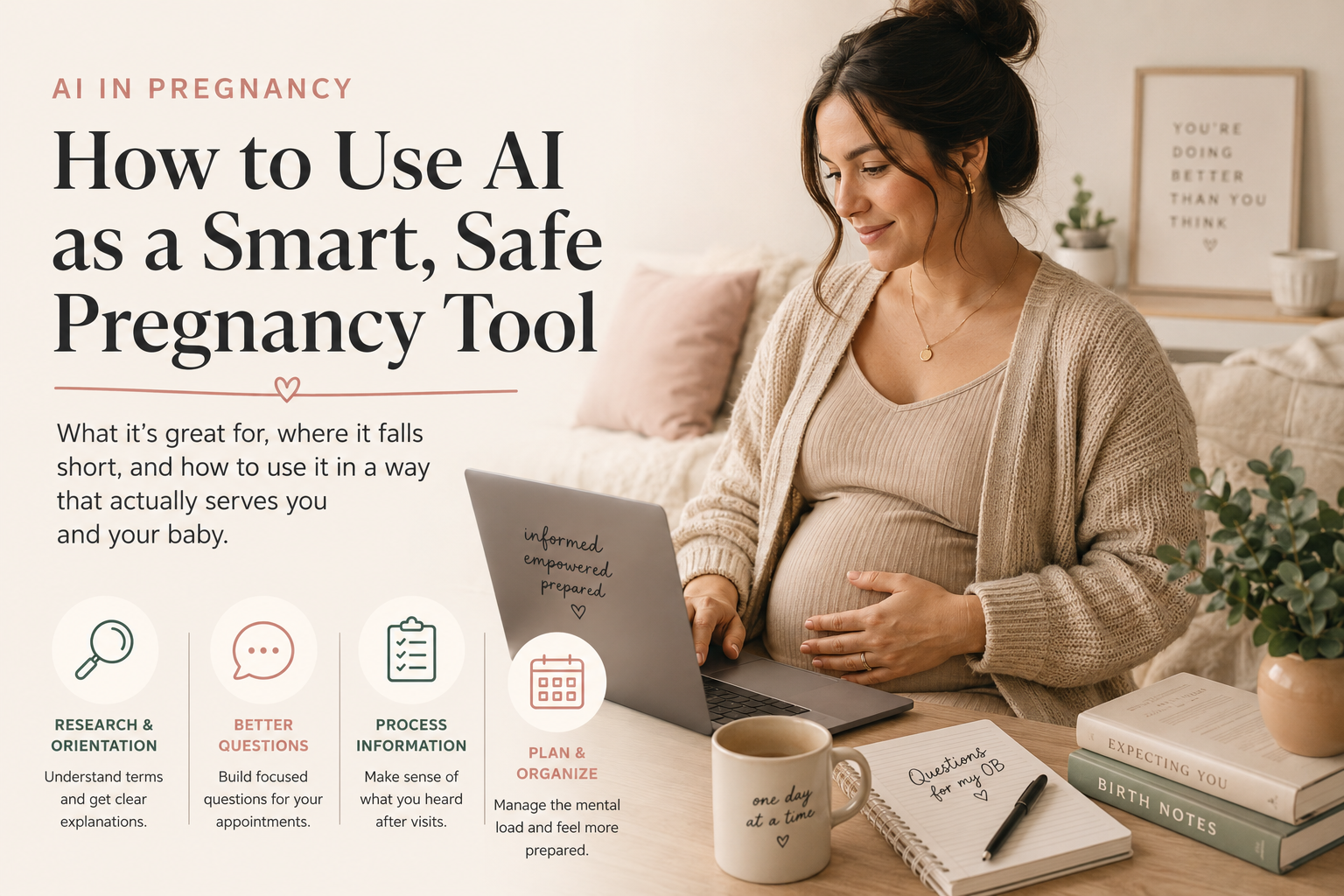
But AI in pregnancy is a topic worth understanding properly, because the stakes are higher here than almost anywhere else. So let’s talk about it honestly: what it’s genuinely good for, where it falls short, and how to use it in a way that actually serves you and your baby.
What AI is genuinely good for during pregnancy
Research and orientation — especially after hours
One of the hardest things about pregnancy is that questions don’t follow office hours. You get a test result at 4pm on a Friday. You read a term in your discharge paperwork that you don’t recognize. You wake up at 3am with a new symptom and you’re not sure if it warrants a call or can wait until morning.
AI is remarkably good at helping you orient. It can explain medical terminology in plain language. It can give you a solid overview of a condition so you walk into your next appointment already understanding the basics. It can help you distinguish between what sounds like it needs immediate attention and what can wait — not as a replacement for your provider’s judgment, but as a first filter when you’re trying to decide whether to call.
Use it this way and it genuinely helps.
Preparing better questions for your provider
This might be AI’s single most valuable use in prenatal care, and it’s underused.
Most of us leave appointments having forgotten half of what we wanted to ask. We feel rushed, don’t want to seem difficult, or genuinely can’t organize our thoughts in the moment. AI can help you build a focused, specific list of questions before every appointment based on what’s actually happening for you right now.
Try something like:
“I’m 28 weeks pregnant and I was just told I have gestational diabetes. What are the most important questions I should ask my OB at my next visit?”
The list you get back won’t be perfect — you’ll add and remove things — but it gives you a starting point, and it often surfaces questions you wouldn’t have thought to ask.
Processing information after appointments
Prenatal appointments are fast. You absorb maybe 60% of what’s said in the room, especially if you hear something unexpected. AI can help you make sense of what you heard afterward: look up terms, understand what a recommendation means, and think through your options before your next visit.
Think of it as the knowledgeable friend you debrief with on the drive home.
Mental load and logistics
Pregnancy generates an enormous amount of information to track and decisions to make — birth plans, hospital bag lists, pediatrician research, understanding insurance benefits, navigating parental leave. AI handles all of this well. It won’t make decisions for you, but it can organize your thinking, draft documents, and help you research options so you show up to those decisions more prepared.
Where AI falls short — and why it matters more here
It doesn’t know you
This is the fundamental limitation, and it matters enormously in pregnancy.
AI gives you population-level information. It tells you what is generally true, what is common, what the research shows across large groups of women. What it cannot do is account for your specific history, your specific anatomy scan findings, your specific lab values, your specific risk factors, or the clinical judgment your provider builds from actually knowing you across multiple visits.
A symptom that’s completely benign for most pregnant women may mean something different for you specifically. An AI tool has no way to know that.
The data has gaps — especially for pregnant women
Here’s something the AI industry doesn’t talk about enough: medical AI systems are frequently trained on data that underrepresents pregnant women. Pregnancy has historically been excluded from clinical trials. Women’s health conditions have been underfunded and understudied for decades. The AI tools being built now are, in many cases, built on that same incomplete foundation.
This is a known problem, one that researchers and women’s health advocates are actively pushing the industry to address. But it’s worth knowing, as someone using these tools right now, that the gap exists. The information AI gives you about pregnancy may be less complete, less current, and less representative than it appears.
It can sound more confident than it should
AI tends to present information in a way that feels authoritative and complete. It doesn’t naturally hedge. It doesn’t say “I’m not sure” or “this is genuinely uncertain in the literature.” For most topics that’s mildly annoying. In pregnancy, where uncertainty is real and nuance matters, it can lead you to feel more certain than the actual evidence warrants.
Pay attention to how confident a tool sounds and be more skeptical, not less, when it sounds very sure.
It is not a triage tool
If something feels wrong — reduced fetal movement, bleeding, severe headache, pain, pressure, anything your body is telling you needs attention — do not start with AI. Call your provider, your labor and delivery unit, or go in. The cost of a call that turns out to be nothing is low. The cost of not calling is not.
A practical framework for using AI during pregnancy
Think of AI as your research assistant and preparation tool, not your clinician.
- Before appointments: Research, understand your situation, and build your question list.
- After appointments: Process what you heard and look up what you didn’t understand.
- For logistics: Birth plans, checklists, insurance questions, anything that doesn’t require clinical judgment.
Hold this line clearly: AI helps you be a more informed patient. Your provider makes the clinical decisions. Those are two different roles, and the best outcomes happen when both are working well.
The bigger picture
We are in early days with AI in healthcare. The tools will get better. The oversight frameworks are being built right now — imperfectly, and with real questions still open about who’s setting the standards and whether the right voices are at the table.
What I know from years at the bedside is this: informed patients have better outcomes. Women who understand what’s happening, who ask good questions, who advocate for themselves, they do better. If AI helps you do that, it is absolutely a tool worth using.
Just use it with your eyes open.
The content on The Mother Baby Nurse is written for educational purposes only. It is not intended to replace the advice, diagnosis, or care of your physician, midwife, or any other qualified healthcare provider. Always consult your provider with questions about your pregnancy, your health, or your baby’s health — and never delay seeking care based on something you’ve read here. If you are experiencing a medical emergency, call 911 or go to your nearest emergency room immediately.

Kirsten Fisch, MSN, RNC-MNN, IBCLC, LCCE Kirsten is a women's health nurse who specializes in high-risk pregnancy and postpartum care. She is certified in Maternal Newborn Nursing, a board-certified lactation consultant (IBCLC), and a Lamaze Certified Childbirth Educator. She works with women from conception through the postpartum period. Passionate about empowering women throughout their reproductive journeys, Kirsten combines evidence-based care with compassionate support to promote the health and well-being of mothers and babies.